
Bridging the refinancing gap
Authors: Johannes Reis, Partner, PANDOO Management | Michael Gangolf, Senior Portfolio Manager, PANDOO Management
Refinancing wave faces cautious banks
Europe’s real estate markets remain locked in a multi-year refinancing and restructuring cycle in 2026. In “Risiken im Fokus 2026”, BaFin once again classifies commercial real estate as a key focus risk — with persistently low transaction volumes, valuation pressure and an NPL ratio that rose in the third quarter of 2025 to 4.4% at less significant banking institutions and 6.4% at significant banking institutions.¹ Faced with higher capital requirements and continued interest rate uncertainty, banks are still acting cautiously; at ‑9.74 points, the BF.Quartalsbarometer for Q1 2026 continues to signal a cautious approach for lending — although 27% of banks report growing new business volumes and 32% a declining NPL ratio.² CBRE’s European Lender Intentions Survey confirms that alternative lenders expect stronger growth in new lending across Europe than traditional banks.³ Alternative lenders — debt funds in particular — have therefore finally transitioned from stopgap solutions to structural market participants.
Real estate debt funds as a pragmatic answer
Alternative providers are systematically expanding their activities. The focus remains on lower-risk structures such as senior loans in preferred segments, for example residential or logistics. As markets gradually pick up, there is also growing demand for whole loans and bridge financing — as a “bridge to exit” or a “bridge to transition” during energy-efficiency refurbishments.
Luxembourg real estate debt funds can bridge capital gaps, finance refurbishments within existing portfolios and facilitate real estate transactions. They create liquidity in challenging market conditions where bank financing is limited, and they enable value-enhancing development of existing assets — from refurbishment to ESG transformation and necessary changes of use.
In the day-to-day management of alternative real estate debt funds, this is not theory for us as a service AIFM but current market reality. Key issues include liquidity shortfalls on the borrower’s side, non-compliance with loan terms and conditions, and difficulties in securing follow-on financing due to changes in the valuation of the underlying collateral. In such situations, new equity and a restructuring of the refinancing structure can be the solution. Managing such situations requires close collaboration between the investment adviser, the sponsor and the service AIFM. For investors, it is precisely this level of support that is crucial: it determines how effectively stress scenarios are managed — and how much value is preserved during the recovery process.
Why Luxembourg — the location as a competitive advantage
With around EUR 8.4 trillion in assets under management, Luxembourg is not only the largest fund domicile in the EU, but also the second largest in the world after the United States. Around EUR 3.2 trillion of that total is attributable to alternative investment funds.⁴ Roughly 48% of global cross-border fund distribution takes place via Luxembourg fund structures. In the private assets segment, Luxembourg's alternative funds have experienced annual growth of around 25% in recent years.⁵ For debt fund managers, this is about more than just location: it is about access to a functioning marketplace with a high concentration of specialised service providers.>
Three building blocks form the foundation:
- Regulatory and legal stability and flexibility for every investment purpose: structures such as SICAVs, RAIFs and SIFs offer flexible solutions for a variety of investment needs.
- A well-established ecosystem: the CSSF as regulator, a broad choice of depositary banks, central administrators, auditors and experienced law and tax firms — all within a single working day’s reach. That shortens routes and speeds up decision-making.
- EU passporting: funds domiciled in Luxembourg can be distributed across the entire EU — the key lever for attracting international investors.
This environment is particularly beneficial for setting up new investment fund structures. In particular, the Reserved Alternative Investment Fund (RAIF) gives institutional investors rapid market access without the need for product-related authorisation (time to market). The RAIF is not subject to direct product supervision, but it is regulated indirectly: it must be managed by a fully licensed AIFM that is under the direct supervision of the CSSF. The RAIF has long since become the market standard — 64% of Luxembourg’s private debt funds are structured as RAIFs, with institutional investors accounting for 82% of the market.⁶
64% Luxembourg’s private debt funds are structured as RAIFs.
Governance as a key success factor
However attractive the structures may be, one thing is clear: managing a real estate debt fund requires more than just asset management. The service AIFM is the regulated backbone of the fund structure. Its three core functions — portfolio management, risk management and valuation — ensure the necessary corporate governance
- investment approvals are granted by an AIFM investment committee;
- formalised product and risk policies (including a risk matrix, investment limits and ongoing risk indicators);
- independent external valuations of collateral, together with oversight of the valuers;
- anti-money-laundering checks as part of every investment process.
For investors, this model means, in concrete terms: no investment decision without independent review, no valuation of collateral without external validation — and a regulated point of contact under the direct supervision of the CSSF.
Managing a real estate debt fund demands more than asset management alone.
Since 16 April 2026, tightened requirements have applied to loan-originating funds under the Luxembourg implementing act of 3 March 2026. These include harmonised rules on lending by AIFs — such as leverage caps of 175% of net asset value for open-ended and 300% for closed-ended loan-originating funds, risk retention and concentration requirements, new liquidity management tools and extended transparency obligations (including enhanced reporting duties from 16 April 2027; transitional arrangements for existing funds until 2029). The result is greater comparability and higher investor confidence, both of which are invaluable during periods of intensive restructuring.
The new directive is based on the idea that lending activities are essentially illiquid and that real estate debt funds should therefore ideally be closed-ended. Open-ended real estate debt funds are permitted only in exceptional cases. In these cases, the AIFM must demonstrate to the CSSF that its liquidity and risk management framework is compatible with the fund’s investment strategy and redemption terms. Adequate and appropriate liquidity management tools must also be in place.
AIFMD II effectively requires institutional liquidity management similar to that of open-ended real estate funds or certain UCITS structures.
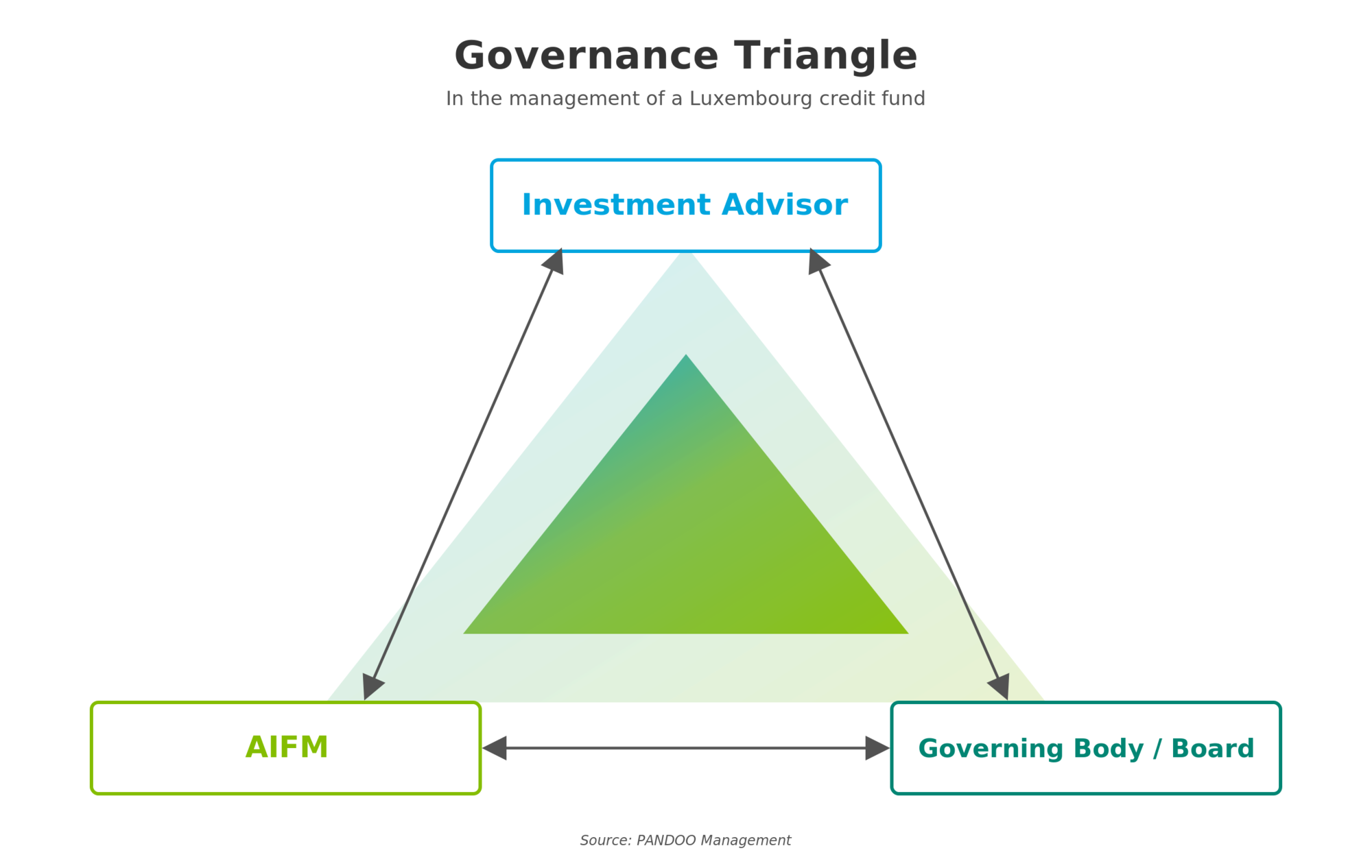
The governance triangle
In practice, the governance triangle between the investment adviser, the service AIFM and the fund management board has proven itself for debt fund managers:
- The investment adviser identifies and structures transactions and issues investment recommendations to the AIFM.
- The AIFM assesses suitability, risks, compliance and investment limits, takes the investment decision in the AIFM investment committee and carries out ongoing monitoring.
- The management board of the debt fund implements the final decision. Optionally, an advisory committee is informed about the fund’s development and its investments.
Why a specialist service AIFM makes the difference
In Luxembourg, external service AIFMs bring together specialist staff, standardised processes and proven reporting. An initiator launching a real estate debt fund can focus on investment sourcing and delegate the regulatory compliance to a specialised partner. In a consolidating market, three qualities are especially important:
- Focus rather than universalism: boutique AIFMs that concentrate exclusively on alternative asset classes — such as real estate, private equity, infrastructure and private debt — are familiar with the specifics of real estate debt funds from their own daily work.
- A partnership-based service approach: regulation is shaped ahead of time, not simply administered. Even before AIFMD II, we proactively carried out gap analyses for every real estate debt fund we manage, presented the findings to the funds’ management board and coordinated the necessary amendments to the fund documentation together with the fund lawyers — without the initiators or investors having to become active themselves.
- AIFMD II-ready by design: anyone who aligns their structures, tools and processes with the new regulatory requirements early, will enter the tightened regulatory regime with a clear head start rather than in catch-up mode.
Conclusion
The refinancing gap will not close by itself or through banks alone in 2026. Luxembourg real estate debt funds provide the regulated fund structure, while a regulated service AIFM takes care of the organisational steering. Combining the advantages of the domicile with a robust regulatory framework brings together the agility of alternative lenders and sound corporate governance, creating the basis for financing transitional phases in the real estate industry in an orderly way.
Sources
- BaFin (2026): Risiken im Fokus 2026 – Gewerbeimmobilienmärkte, www.bafin.de (published February 2026).
- BF.direkt AG / Handelsblatt Research Institute (2026): BF.Quartalsbarometer Q1 2026 (survey March 2026).
- CBRE (2026): European Lender Intentions Survey 2026 (published June 2026).
- ALFI (2026): Luxembourg Fund Industry Statistics, as at March 2026 (accessed 30/06/2026).
- ALFI (2026): ALFI/KPMG Private Debt Fund Survey 2025 (published October 2025).
- ALFI (2026): ALFI/KPMG Private Debt Fund Survey 2025 (published October 2025).
This article was first published in Pegasus Private Debt Report 2026 (PDF).
Contact

Johannes Reis
Partner PANDOO Management
31, rue de Hollerich | L-1741 Luxembourg | Grand Duchy of Luxembourg
Phone. +352 267 384 491 | Mobile. +352 621 583629
johannes.reis@pandoo-management.lu

Michael Gangolf
Senior Portfolio Manager
PANDOO Management
31, rue de Hollerich | L-1741 Luxembourg | Grand Duchy of Luxembourg
Phone. +352 267 384 475 | Mobile. +352 621 766 285
michael.gangolf@pandoo-management.lu